FLOW CAMPUS


Project idea
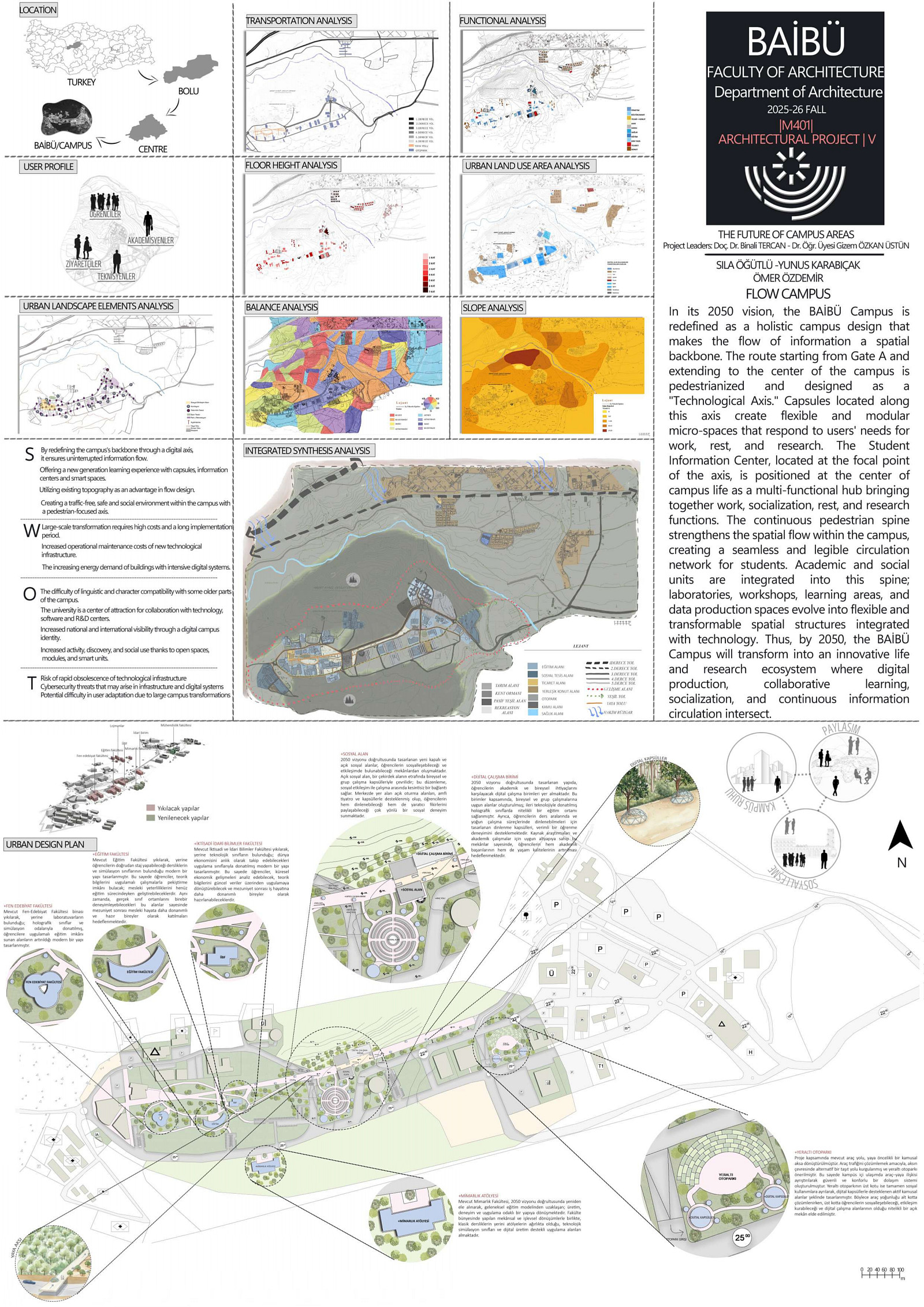
In its 2050 vision, the BAİBÜ Campus is redesigned as a holistic campus structure that makes the flow of information a spatial backbone, a "Technological Axis." Capsules located along this axis, serving as Student Information Centers, work, socialization, rest, and research facilities, strengthen spatial flow, creating a flexible and transformable spatial structure for students, and evolving into uninterrupted and legible spaces. Thus, BAİBÜ Campus is defined as follows:
K
starting from Gate A, it creates flexible and modular micro-spaces that respond to the needs of learning and research and extend to the center of the campus, pedestrianizing the route. It is designed and located at the focal point of the area, creating a highly functional attraction point. It forms an academic network. It is positioned at the center of campus life, fostering digital production, collaborative learning, and academic and social interaction. Continuous processes are integrated into this backbone; the pedestrian backbone showing the connection between the laboratory, the campus content, the workshops, learning and data production areas, the technology areas, the innovation of socialization and continuous information circulation, and the integration of the logic into an innovative life and research ecosystem transforms into something.
Project description
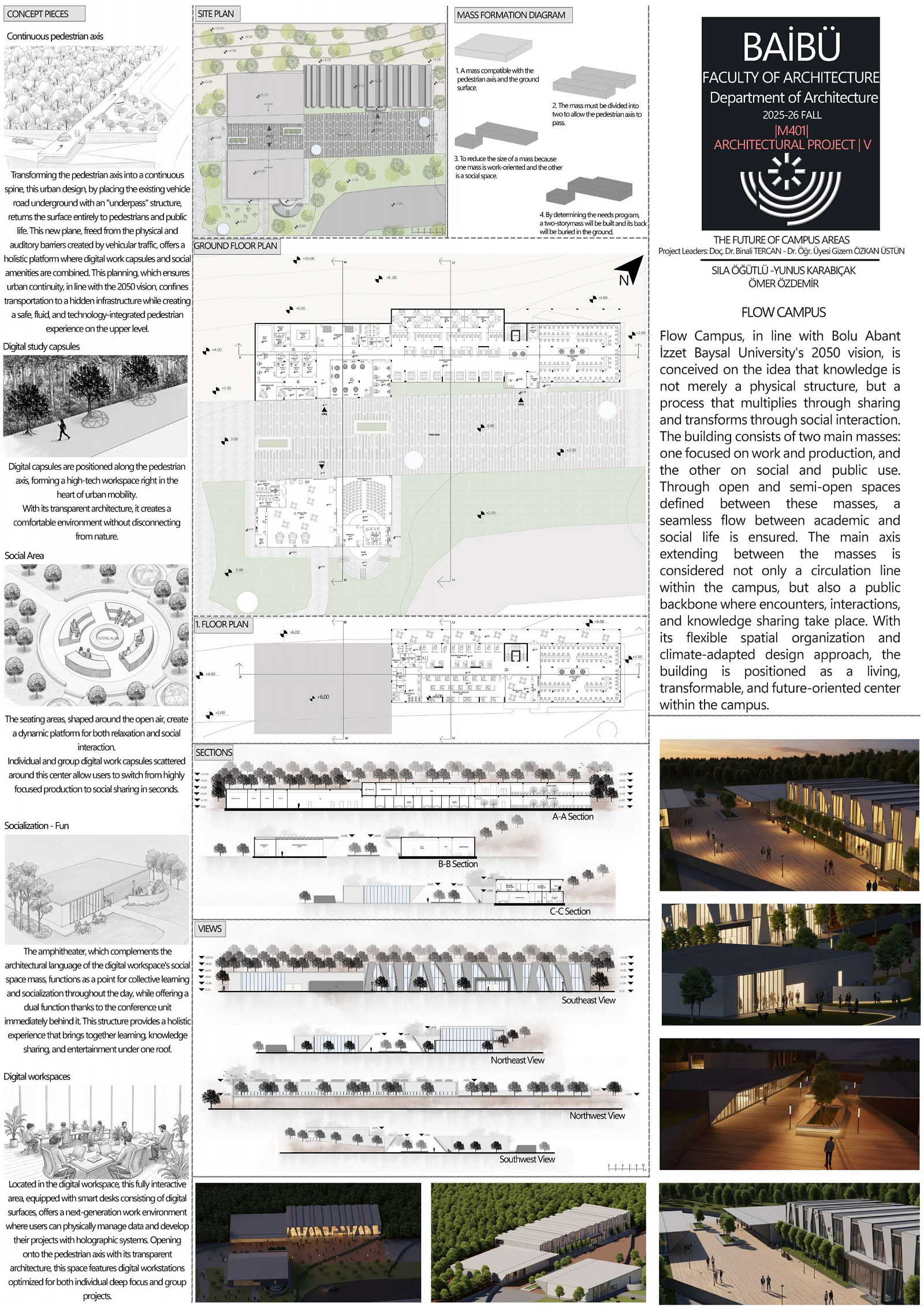
Flow Campus, in line with Bolu Abant İzzet Baysal University's 2050 vision, is based on the idea that knowledge is not merely a physical structure, but a process that multiplies through sharing and transforms through social interaction.
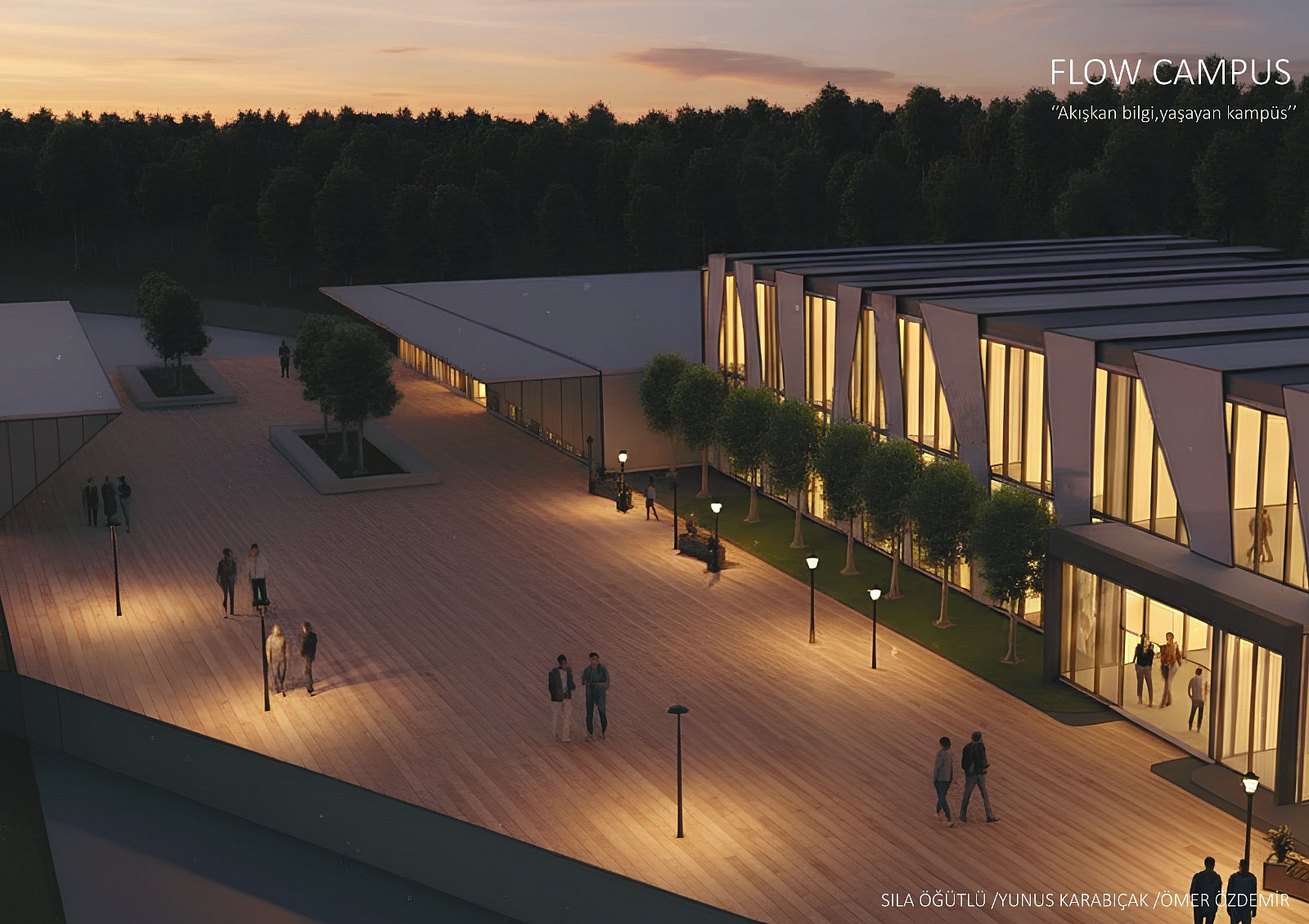
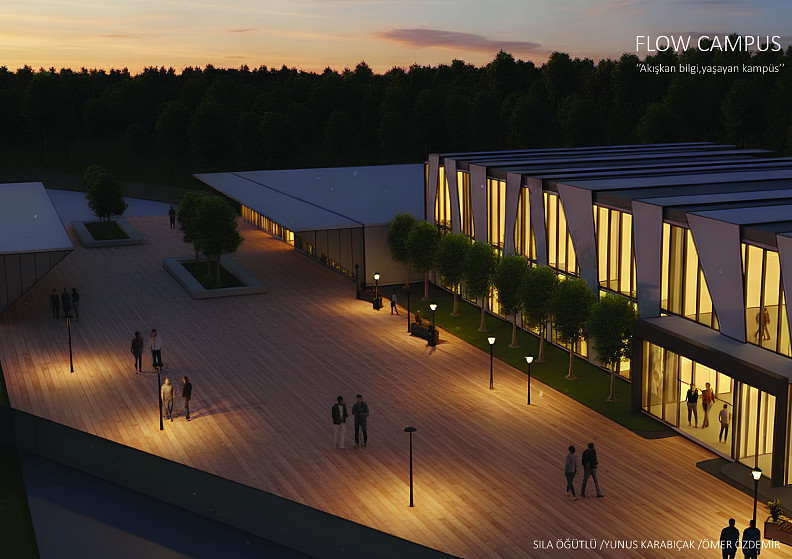
The building consists of two main masses, one focused on work and production, and the other on social and public use; through the open and semi-open spaces defined between these masses, a seamless flow between academic and social life is ensured. The main axis extending between the masses is considered not only a circulation line within the campus, but also a public spine where encounters, interactions, and knowledge sharing take place.
With its flexible spatial organization and climate-compatible design approach, the building is positioned as a living, transformable, and future-adapting center within the campus.
Technical information
We designed the work unit with two separate entrances to respond to different user scenarios. Upon entering through the main entrance, the user is first greeted by a reception area, from where the overall organization of the space can be easily understood. On the right side of the entrance are more open and shared workspaces, while on the left side are more controlled spaces designed for individual and group work. We concentrated the volumes that do not require light, especially on the rear facade, and positioned holographic classrooms in this area. In the left mass, there are production and experience-based spaces such as VR rooms, 3D printing areas, collaboration clubs, music rooms, and technical areas. In bringing these spaces together, we aimed to enable users to easily switch between different production processes. In the social area of the building, we designed a flexible social space where students can sit, spend time, and eat and drink. In addition, we designed a conference hall for smaller-scale conferences and talks. We designed the waiting and preparation areas of this hall to be shared with the outdoor space, and furthermore, we aimed to create a strong relationship between the indoor and outdoor spaces by designing an amphitheater area in the open space. In this entire ground floor design, we envisioned and designed a space where learning, production, and socialization are intertwined, a space that is alive at different times of the day. We designed the first floor plan as a quieter and more focused workspace compared to the ground floor. There is a shared workspace, and considering that students might get tired during long study sessions, we designed rest pods on this floor. There is also a small social area on this floor where students can eat and drink something during short breaks from their studies. In addition, we designed a meditation room to support mental relaxation. One of the most important features of the first floor is that it opens onto a terrace; this terrace overlooks the forest and aims to make the study process more balanced and sustainable by offering students a calm environment supported by fresh air, natural light, and birdsong.
Documentation

Copyright © 2026 INSPIRELI | All rights reserved. Use of this website signifies your agreement to the Terms of Use, Privacy Policy, and use of cookies.
