Latent pavilion


Project idea
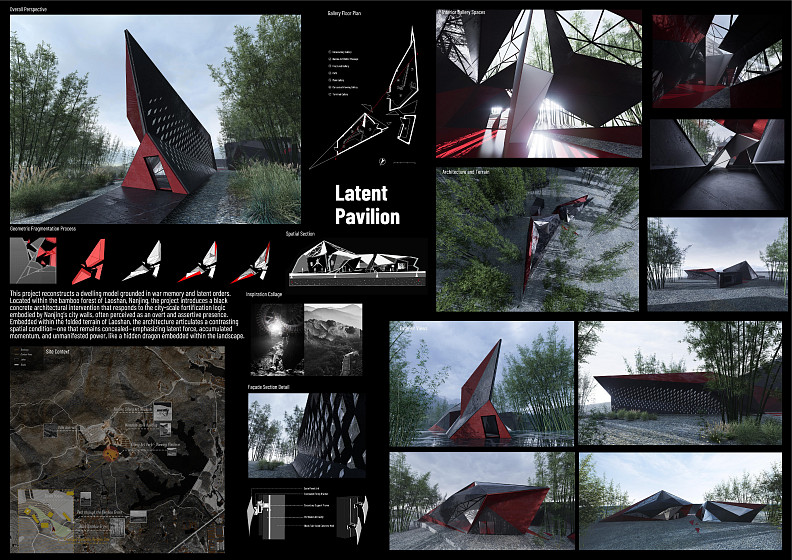
The project introduces the concept of Hidden Dwelling, contrasting with the openly visible and communal notion of “dwelling” discussed in class. In Laoshan, everyday life unfolds along concealed mountain paths—routes leading to temples, caves, patrol lines, and informal exchanges—forming an alternative spatial logic embedded within forested terrains.
These hidden routes operate as invisible infrastructures, supporting ritual, defense, and movement, and collectively define a dwelling mode shaped by concealment rather than exposure.
Project description
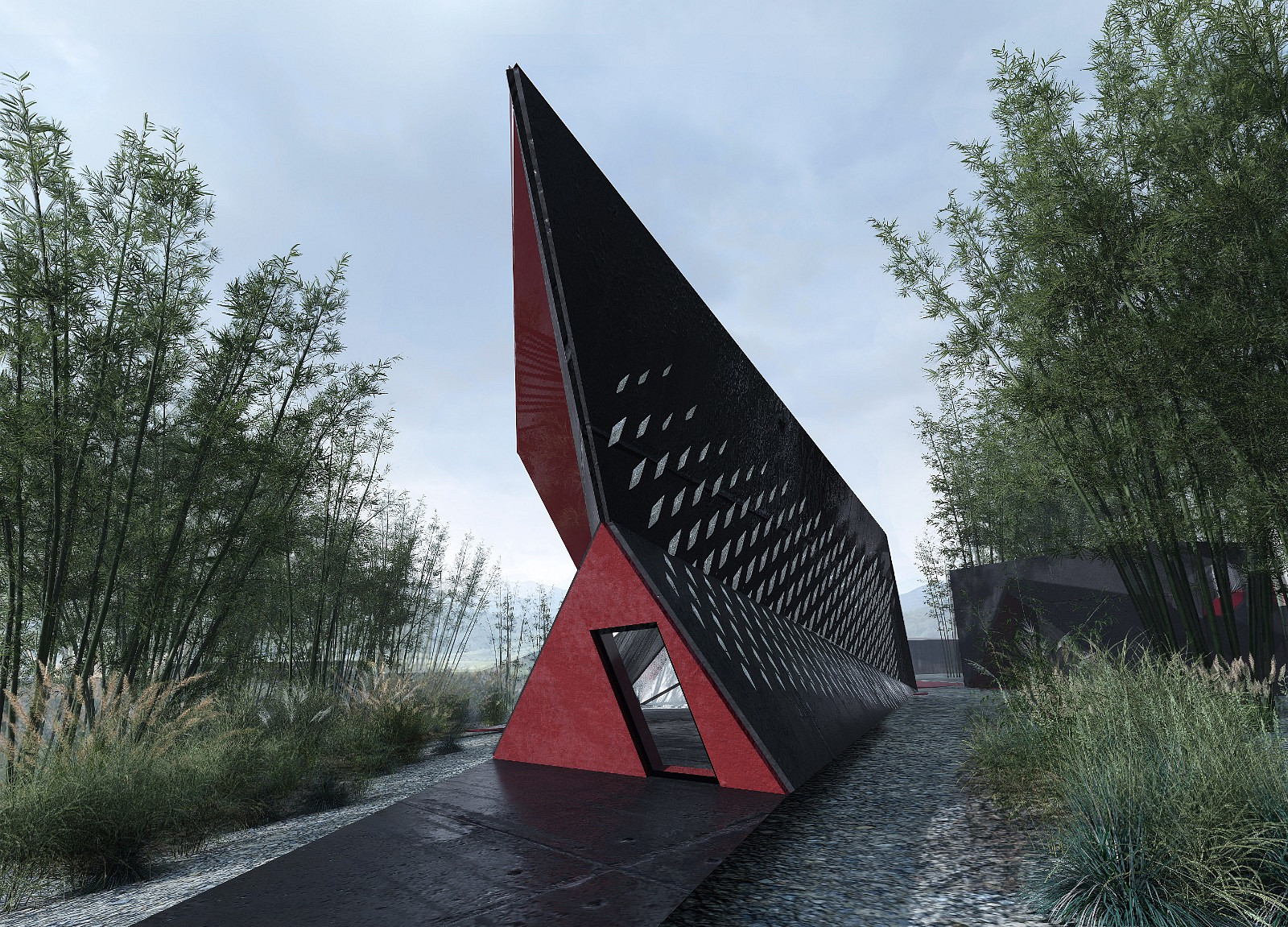
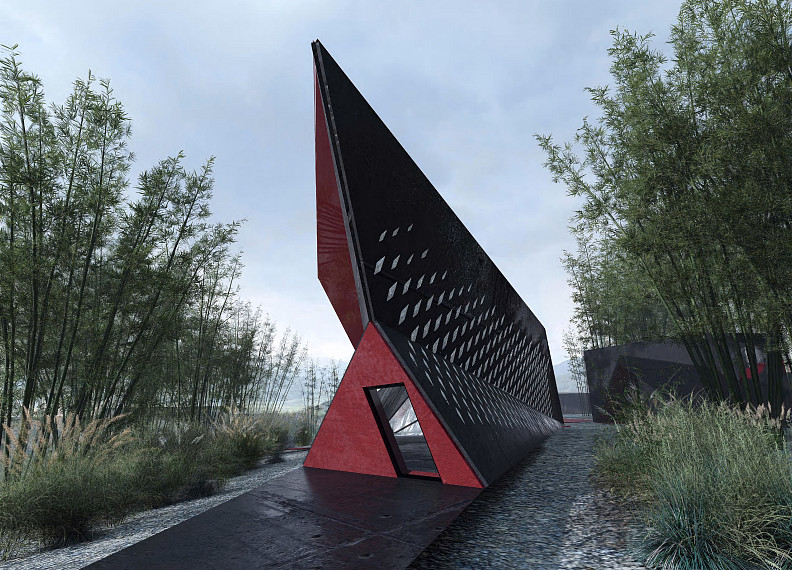
Located within the bamboo forest of Laoshan, the project introduces a black concrete architectural intervention that contrasts Nanjing’s visible fortification systems. While the city wall represents an exposed and assertive “dragon,” this project constructs a hidden counterpart—an architecture embedded within folds of terrain.
Through compressed circulation, enclosed massing, and defensive façade articulation, the building spatializes concealed routes and practices, translating hidden cultural behaviors into architectural experience.
Technical information
The pavilion adopts a triangulated reinforced concrete structure composed of inclined folded planes that form a self-stabilizing conical spatial envelope. The concrete plates act simultaneously as load-bearing walls and roof surfaces, transferring forces directly to the foundation through geometric compression. Attached to this primary structure is a secondary dragon-scale façade system, composed of prefabricated panels mounted on steel brackets fixed to vertical sub-rails anchored into the concrete shell. This non-load-bearing outer skin creates depth, shadow articulation, and dynamic light filtration, enhancing the three-dimensional perception of the building while maintaining structural independence from the core concrete framework.
Documentation

Copyright © 2026 INSPIRELI | All rights reserved. Use of this website signifies your agreement to the Terms of Use, Privacy Policy, and use of cookies.
