Rethinking Workshops Matrix: A New Urban Narrative for Micro Metal Industry.


Project idea
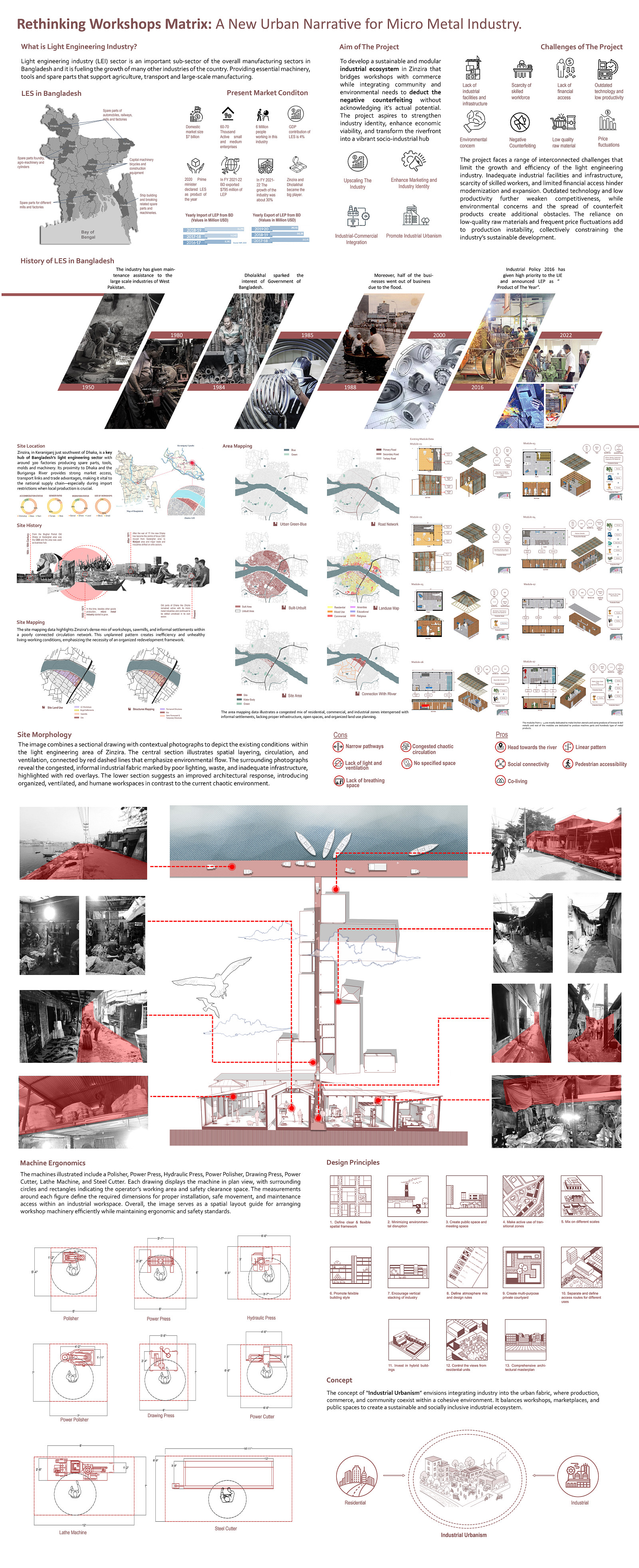
Zinzira, located on the southern edge of Dhaka, is home to one of Bangladesh’s most concentrated clusters of light engineering workshops. For decades, this micro-industrial hub has played a vital yet under-recognized role in the national economy, supplying machine parts, tools, and repair services to industries across the country. Despite its economic significance, Zinzira’s urban fabric suffers from severe infrastructural deficiencies—narrow and congested circulation networks, inadequate transportation links, poor lighting and ventilation, and unsafe working conditions. These challenges limit productivity, threaten worker health, and hinder the industry’s capacity to evolve in an increasingly competitive market.
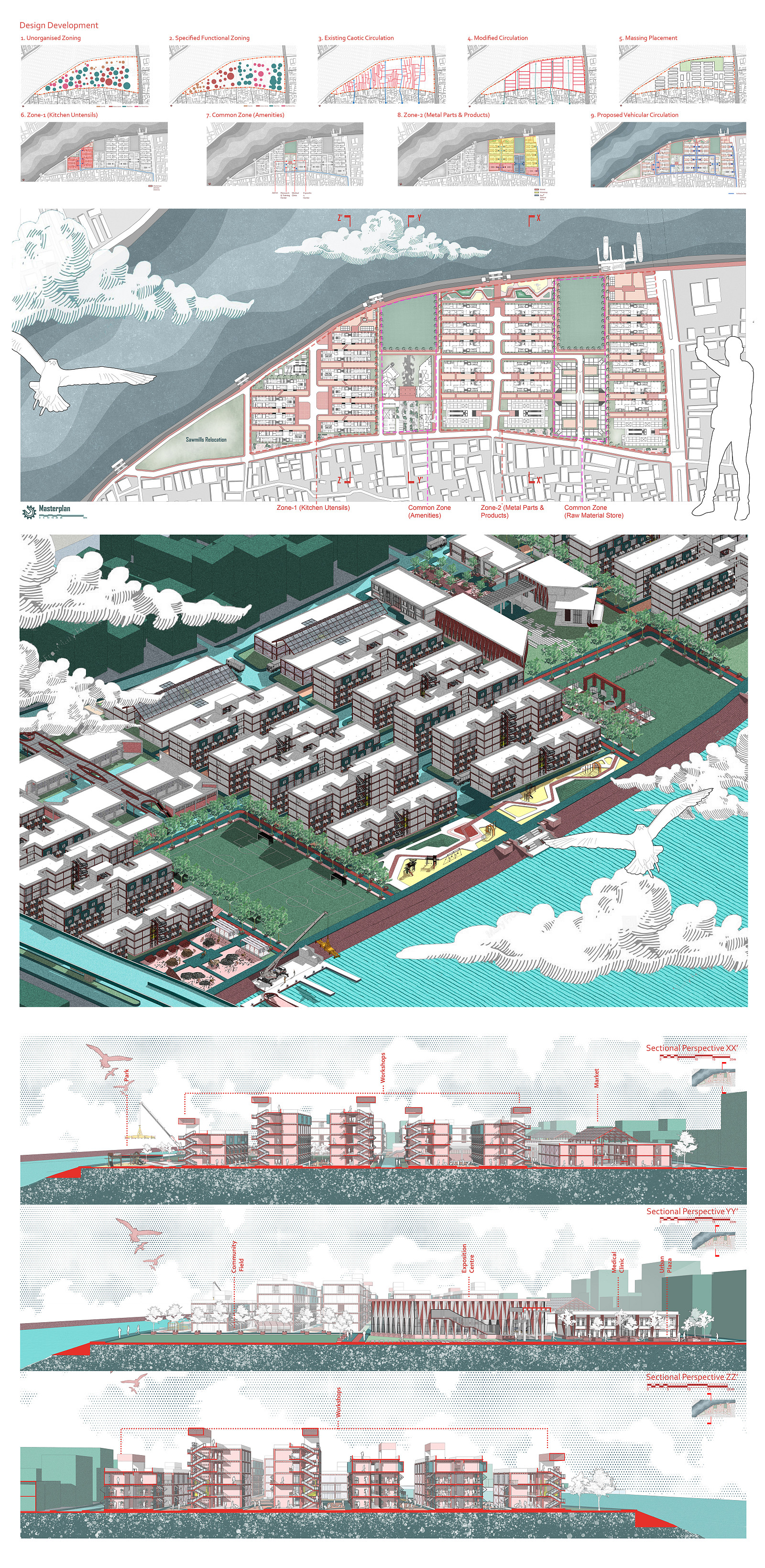
This project investigates how architectural and urban interventions can bridge the gap between industry and commerce in Zinzira, transforming it from a dense, fragmented cluster into a more integrated and sustainable industrial ecosystem. Through site analysis, stakeholder engagement, and design exploration, the project proposes a framework that reconfigures spatial organization, introduces modular and flexible workshop typologies, improves transport and logistics infrastructure, and integrates public amenities to foster healthier working and living environments.
Project description
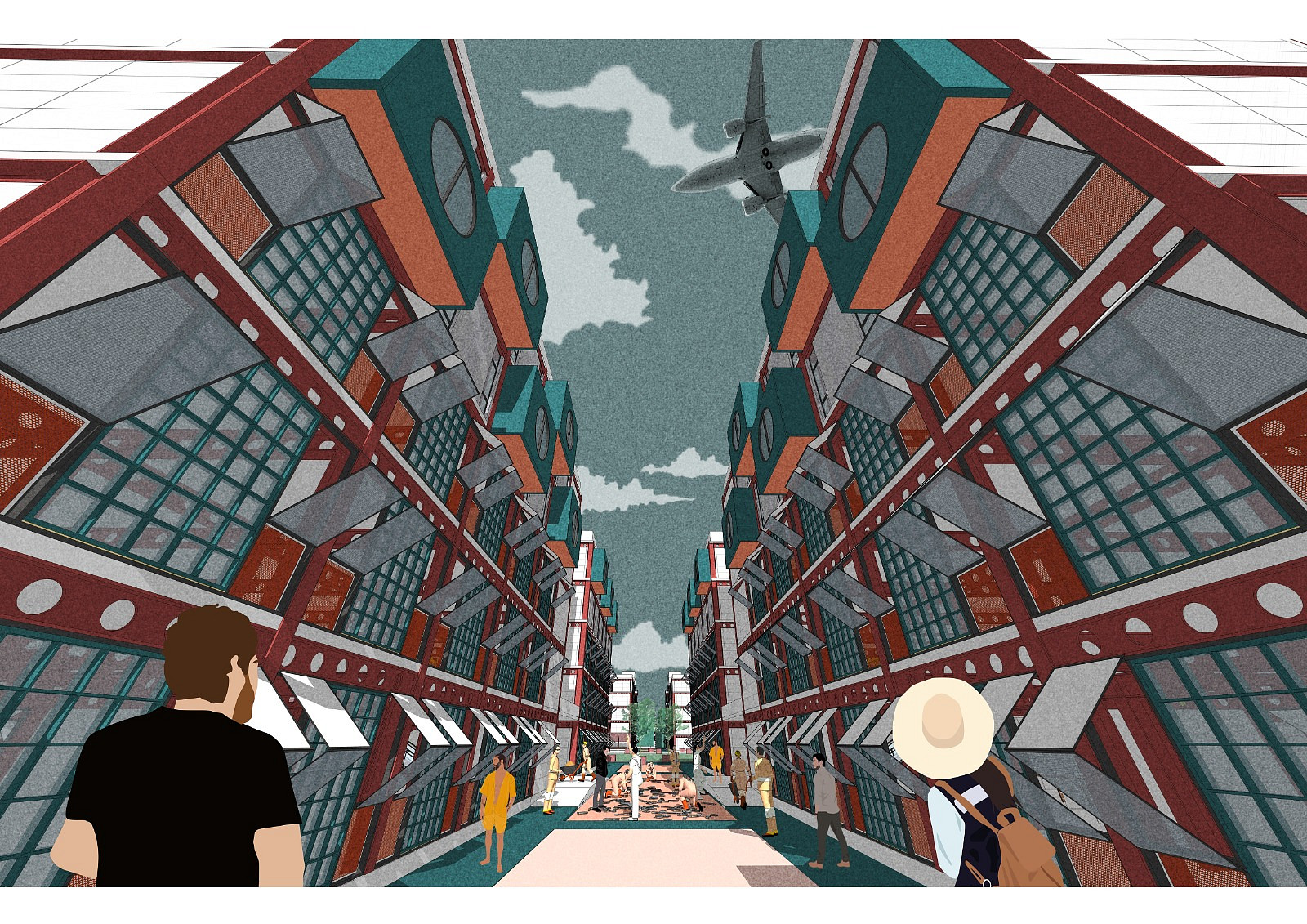
This project, Rethinking Workshops Matrix: A New Urban Narrative for Micro Metal Industry, Zinzira, is framed within the discourse of industrial urbanism, which posits industry not as an isolated enclave but as an active component of the urban continuum. Situated along the southern edge of Dhaka, Zinzira embodies one of Bangladesh’s most concentrated clusters of light engineering workshops, sustaining a vital yet under-recognized role in the national economy. Despite its significance, the district remains spatially fragmented, constrained by inadequate infrastructure, congested circulation, poor environmental conditions, and an absence of coherent urban integration.
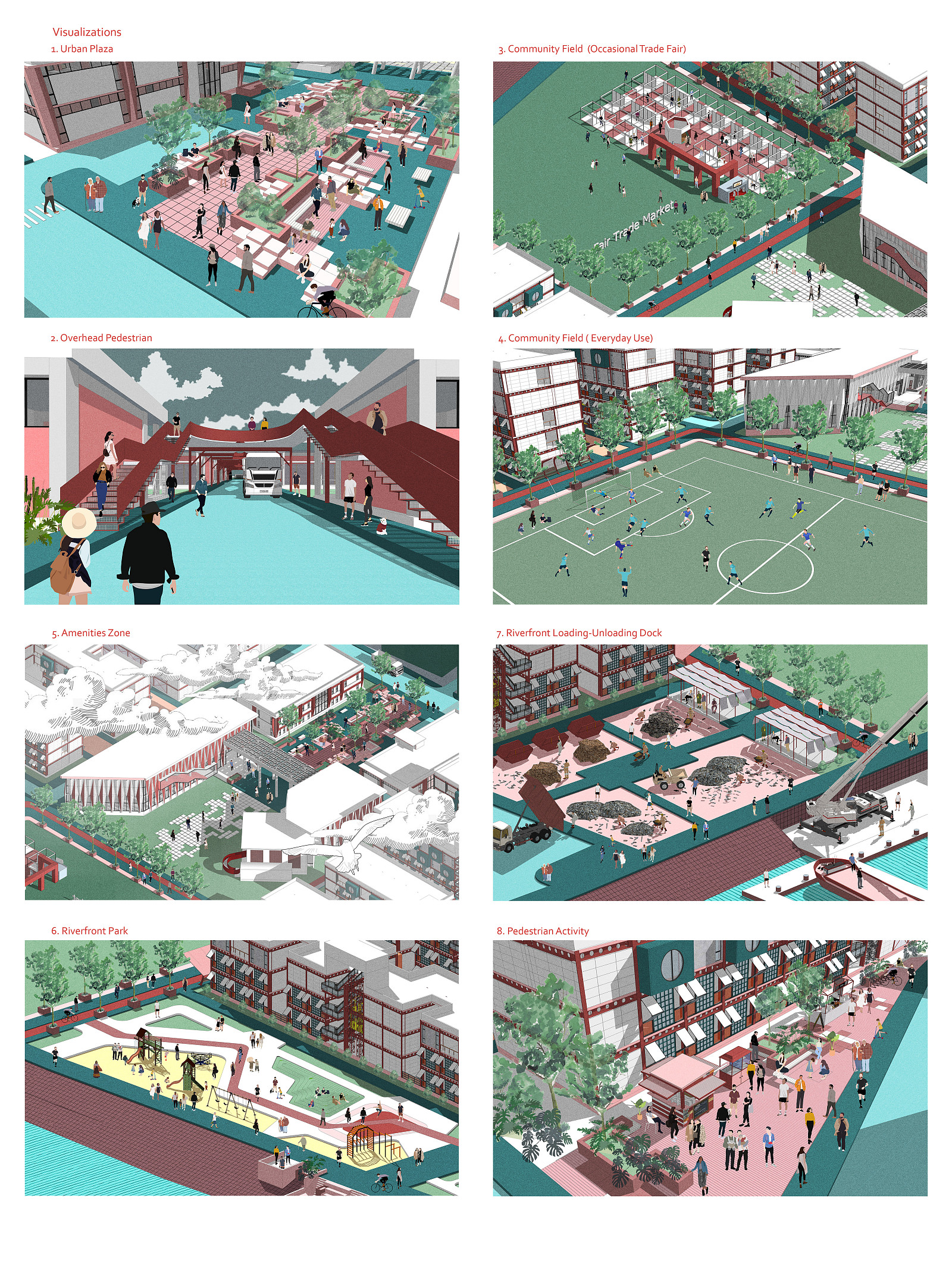
The project seeks to reconceptualize this industrial landscape by advancing a framework that unites production, commerce, and community within a cohesive urban order. Central to the proposal is the introduction of modular, flexible, and adaptive workshop typologies, enabling spatial reconfiguration in response to shifting technological and market demands. Complementing these are commercial interfaces and marketplaces, envisioned not merely as spaces of transaction but as loci of exchange, visibility, and identity formation for the industry.
Furthermore, the riverfront is rearticulated as a hybrid ecological and infrastructural edge, simultaneously accommodating industrial logistics and public life, while reinforcing resilience against environmental degradation. Through this integration, the project aspires to establish a reciprocal relationship between industry and its socio-ecological context.
Ultimately, the thesis positions Zinzira as a prototype for reimagining micro-industrial clusters in rapidly urbanizing territories. By synthesizing modularity, inclusivity, and ecological responsiveness, it articulates a paradigm of industrial urbanism that aspires to reconcile economic vitality with social and environmental sustainability.
Technical information
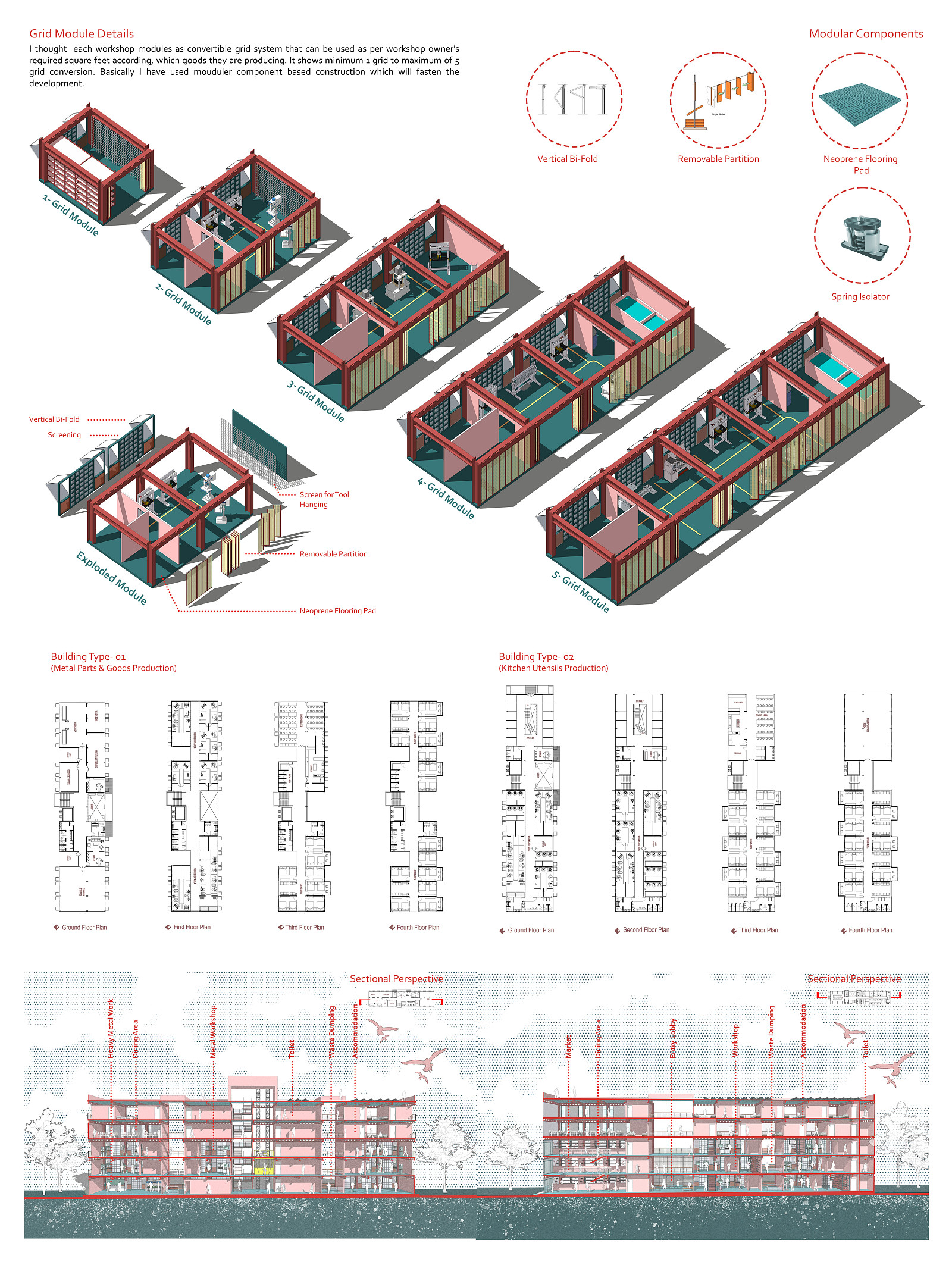
The project is designed using a modular steel frame structural system organized through flexible grid units that can expand from one to five modules depending on the workshop requirements. This adaptable grid system allows different scales of production spaces for various light engineering activities. The use of prefabricated structural components helps speed up construction while maintaining flexibility for future expansion or modification. Interior spaces are designed to be highly adaptable through removable partition panels and vertical bi-fold screening systems, allowing workshops to adjust their layouts according to machinery and operational needs. Perforated tool-hanging screens also help in organizing equipment efficiently within the workspace. To address industrial vibration, the floor system integrates concrete slabs with neoprene flooring pads and spring isolators beneath heavy machines, ensuring structural stability and user comfort. The building façade incorporates ventilated and perforated panels to enhance natural daylight and airflow. Overall, the design promotes a functional, flexible, and efficient industrial environment.

Copyright © 2026 INSPIRELI | All rights reserved. Use of this website signifies your agreement to the Terms of Use, Privacy Policy, and use of cookies.
